Tuesday, September 09, 2008

Large Hadron Collider

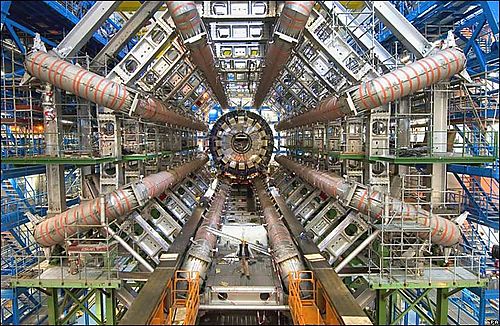
So I decided to start being a loser and read up on this thing called the Large Hadron Collider (I'm going to call it LHC from now on). I don't know why, but I think the cracked.com article about 5 experiments that could end the world tuned me into it. And get this, 3 of those experiments had to do with this LHC thing. 

So what exactly is the LHC? It's a particle accelerator. A VERY BIG particle accelerator. It's basically an underground tube that goes in a circle 17 miles in circumference and goes through 2 or 3 countries. Here are some pictures: 


BEHOLD!!

That's pretty cool-looking


Sweeet


Those are some pretty nice pictures, aren't they...well what exactly do you do with this thing? Well, that machine enables you to shoot little tiny protons around in 17 mile long circles pretty fast. And by pretty fast, I mean close to the speed of light. To put that in perspective, the protons will be able to circle the whole 17 mile long thing 11,000 times every second. Now scientists decided to mount not one, but two of these proton guns onto this thing. And they decided shooting these protons in opposite directions would be the best way to go. Their goal is to have these two protons traveling at the speed of light to collide. Yes, scientists thought that smashing two protons really, really, REALLY hard would yield some interesting results. 

Now, why exactly would they want to do this? Well, I want to let you guys know in advance that I got about half of my information from this sickass video:
Seriously, it simplifies particle physics to an absurd degree. I got the rest of my information from Wikipedia, which is actually pretty tough to understand. 

So where was I? Oh yeah, why would they build this thing...well this is a pretty complicated story. So we live on the planet Earth. Earth is part of this big thing called the solar system, and this solar system is part of this even bigger thing called a galaxy (our galaxy is known as the Milky Way). Then there's this thing called the Universe, which encompasses a several billion or trillion of galaxies. So this Universe thing has been measured to be expanding. How? Well scientists used telescopes and measured the relative placement of stars and other stuff over a period of time. The Hubble was put to very good use I guess. So now we have an expanding Universe, right? Well, then intuitively if we go back in time, the universe will gradually shrink until it's smaller than the smallest thing you can ever conceive, right? Ok...so how did this thing start expanding? Well scientists theorized this event that happened about 13.7 billion years ago called the Big Bang. Since all the energy you can possibly think of was stuck into that tiny little itty bitty space, it became unstable, and thus exploded and kept expanding and expanding. Thus the Universe was formed. W00t!!!


The UUUUUNIVEEEEERRRRSSSEEEE!!!


Well, after a while, scientists discovered some funky stuff about this Universe thing. One is this basic physics law you learn in 8th grade about how the sum of the energy in a closed system is constant.  According to this law, energy can't be created or destroyed; it is merely changed into a different form. This is called the conservation of energy. It makes intuitive sense when you think about it too. When you hit a table, you transfer energy to the table, causing it to shake. Thus you're changing the kinetic energy of your hand into kinetic energy exhibited by the table. A lot of energy is dissipated as heat, which also makes sense because when you rub your hands together, your hands get hotter. 

Now, physicists want to believe that the total energy in the Universe is zero because the Universe is pretty much the biggest closed system ever. Well, behold! Einstein's theory of relativity: E=MC^2. I'm no expert on relativity, so don't ask me the details on it, but basically that equation shows that energy is proportional to mass. Stuff that has mass is generally referred to as "matter," and since there is a conservation of energy, there has to be something that is the opposite of matter, which scientists dubbed "anti-matter." Now you may be thinking to yourself "huh?" and to tell you the truth, that's exactly what I'm thinking now as well. Wow, physics is WEIRD! But wait, it gets even weirder. Apparently, there is a plethora of matter, but very little anti-matter (and by very little, I mean the ratio is like a billion particles of anti-matter to a billion and one particles of matter). "Why this is the case?" you may ask. Well basically...uh...nobody knows. That's where this bigass machine comes in handy. Scientists hypothesize that if we smash two protons together really really REALLY hard, it will simulate a big bang. Since we believe that all matter arose from the big bang, we should theoretically be able to see anti-matter as well. 

Great. We now have a gigantic $6 billion machine that smashes protons together so we can find anti-matter. That's totally worth $6 billion...right? Well, maybe, but there are other uses for it. Perhaps the most scientifically significant one is finding this thing called the Higgs boson. 

To describe this, I'll have to go back again to basic particle physics. So we're all made of molecules, and these molecules are made of atoms, and these atoms are made of smaller things called electrons, protons, and neutrons. And then protons and neutrons are made up of these things called quarks, which are so small it hurts my brain to even mention them. And there are different types of quarks (up quarks, down quarks, strange quarks, *insert random name* quarks, etc.), each of which can produce different kinds of matter. Well, how do these things interact with each other? That is, how do different forces cause these subatomic particles to interact? Well, physicists and mathematicians developed a model for this, called the Standard Model. This Standard Model encompasses all the subatomic particles that they could discover (top quarks, strange quarks, photons, etc.) and describes what exactly they do. Pages upon pages of math were used to derive exactly how everything reacts at this subatomic level. However, a problem arose. 

Before I can tell you what the problem was, I'm going to have to explain the basic structure of the Universe. So everything around us has 4 forces interacting with everything else: the strong force, the weak force, the electromagnetic force, and the gravitational force. In case you didn't pay attention in your chemistry classes, the strong force is what holds protons together in atoms. The weak force causes beta decay, which is a type of radioactive decay where atoms degrade to lesser atoms. The electromagnetic force refers to the effects of magnets and charges on particles, and gravity is, um, what causes us to fall to the ground. 

Now, the Standard Model is remarkably consistent when explaining the strong force, the weak force, and the electromagnetic force, but when you try to factor in gravity, the model collapses. Well, that really sucked, especially when mathematicians and physicists spend god-knows how many hours deriving it. Scientists spent quite a while scratching their heads over this problem. Then one day this guy named Peter Higgs came up with a convenient solution. 

In order for gravity to exist, you need something with mass. You need matter. Well, these subatomic particles are pretty small, so small that the equations in the Standard Model treated them as massless point particles. However, while some of them are (like the photon), a bunch of them aren't (like the top quark). Higgs concluded that there was something that was giving these particles their mass. And then he did what all scientists yearn to do; he named the thing after himself. He called it a Higgs field. Apparently, it's spread throughout the Universe, and as particles like the up quark pass through it, it slows down and starts attaining mass. Yeah, it does sound like something some weirdo made up in 2 seconds, but that's what theoretical physics pretty much is like. Now, all fields require particles to create it. This makes sense; magnetic fields require magnets (or electromagnets), and electric fields require charged particles. So this new particle that makes this Higgs field was creatively called the Higgs Boson. Another valid question would be "What's a boson?" to which I shall respond "You don't want to know." If you do though, they're these itty bitty particles that obey Bose-Einstein statistics, which basically means that if numerous bosons have the same energy, they will occupy the same space. This means if you were a boson and your friend was a boson and you both had the same energy (I don't know, maybe from eating chocolate bars?), you two would exist in the same spot. Hard to image? I agree. I warned you that you didn't want to know. 

Scientists feel that this Higgs Boson is the thing that connects the Standard Model with general relativity, which would be good for all physics. Apparently, by smashing two protons together really really REALLY hard, this elusive particle should appear immediately. Of course, particle physics isn't that simple because the Higgs boson has so much mass that it is incredibly unstable and degenerates into other Standard Model particles after a fraction of a second. Well THAT totally blows, right? Well scientists are determined to detect it, and they planned ahead. They believe that they’ll be able to detect it based on the other Standard Model particles that this elusive boson degenerates to. This is kind of like after a human gets cremated, you’d analyze the ashes to determine that person’s hair color.

Well, on the bright side, if this Higgs Boson is discovered, all of physics can be united. People have been trying to simplify the Universe to basically one line for thousands of years, and with this tiny itsy bitsy (but very heavy) boson, they hope to come up with a theory of everything. There are already theories of everything (string theory, M theory), but they're pretty much all mathematical (not to mention a bunch of the string theories contradict each other, but that's another story). It'll be cool if they can actually make a theory of everything that is derived from direct observation. THAT would be worth $6 billion. One thing that sucks though is that if scientists don't see this Higgs Boson, they'll know there's something wrong with the Standard Model, and then the next couple of years will be spent inventing new physics. Welcome to science. 

There are some other things this machine wants to find as well. There's so much stuff and so many forces in the Universe that scientists want to try and explain. Considering how insignificant and small we are, they've done a reasonably good job. One thing they can't explain though is how the planets and stars act in terms of their gravitational behavior. Their calculations based on what we know suggest one thing, but their observations suggests another. Well, scientists have no idea what's causing this gravitational effect, so they're calling it Dark Matter. What is dark matter? Again, nobody knows. That's why it has such an ominous name. But hopefully they'll be able to see it with this new particle accelerator they built. After all, it pretty much fills the entire Universe and causes stars and planets to interact the way they do, so there's no reason for us not to see it.

The last thing I'll get to is gravity. As stated earlier, it's the weakest intermolecular force of the four. Why is this exactly? Well some scientists theorize that maybe in OUR three dimensions, this force is weak, but maybe if you go on to look at other dimensions, you'd see different. Whoa what? There are other dimensions? Apparently so. M theory suggests that the Universe is a biiigggg massless membrane that vibrates in 11 dimensions. So scientists think that they might be able to indirectly see the effects of gravity in other dimensions. Interesting stuff. I'm pretty sure there's more to this machine than 4 things, but I really don't know (or understand) anything else. 

So why exactly am I typing this up? I don't know, I guess because I'm a loser with no life. Oh, and this thing could potentially END THE WORLD. 

Wait what? You mean we could all die when this thing turns on? Well no...actually yes, that's exactly what I mean. There are a couple ways the world could end.

Some stuff in the Universe that are pretty scary are these things called black holes. There are incredibly dense gigantic pieces of matter that have so much of a gravitational force that not even light can escape from it. That's why it's black. In fact, they're so massive that the ENTIRE MILKY WAY GALAXY REVOLVES AROUND ONE. The smallest black hole that we know of is the primordial black hole, and that has the amount of mass as the moon despite being about .1 MILLIMETERS BIG. Seriously, imagine the moon being compressed into something smaller than the tip of a needle. The moon itself has enough gravitational force to cause tides, and this is despite it being a few million miles away. Imagine something as massive as the moon that is less than a millimeter in diameter right here on earth. Anyone who knows anything about physics can tell you that the relationship between gravitational force and distance is inverse squared, which basically means F=k/(r^2) where k is some constant. Now if this black hole was, say, in a lab on the earth's surface, that r value turns to ZERO, and when a denominator is zero, the whole function turns to infinity. This means we have something pulling on the earth with a force of INFINITY. If this theoretically happened, the earth would get sucked into a hole .1 mm in diameter, and theoretically we'll all be dead. 

So if these two protons collide and manage to form the big bang, there could perhaps be an off chance that it might possibly maybe create a black hole that could totally screw up our day. Now I did see a video where this woman working on the LHC assured the audience that this will not happen, but you should've seen the look on her face when she said it. Man, that sure wasn't encouraging. It's probably because everyone knows that there at least is a slight possibility of certain death (although slight probably means 1:10^10^10^a googol^a googolplex, fairly good odds against it), and if the experiment just happens to be that one off chance, we're all doomed. 

So we have the potential of earth getting sucked into a black hole that's smaller than a pinpoint, but is that really it? You probably think I'm kind of paranoid, right?

Well I probably am, but there are other things to worry about, like Strange Matter. This type of matter is basically a soup of up quarks, down quarks, and strange quarks, and it can be used to create relatively large quark stars (which are about a mile wide) or very small strangelets (which are aobut the size of nuclei). The thing about strangelets is that it caused scientists to come up with this Strange Matter Hypothesis, which states that since strange matter is far more stable than normal nuclei, all the atoms around us can convert to strange matter. This is usually triggered naturally over the course of billions of years, but it can also occur if strange matter comes in contact with ordinary matter. This means that if strangelets come in contact with you, your atoms will turn into strangelets, and you will eventually turn into Strange Matter. Well, how is Strange Matter produced? High energy collisions, which is exactly what this LHC is going to do. 

But don't worry. High energy collisions happen in the atmosphere all the time because of the cosmic rays hitting the atmosphere, right? Well, yes, but those cosmic rays take a little while to actually reach us (on the order of billions of years). So, some scientists think that the only reason that we don't notice anything is because whatever strangelets are created have already decayed into something that won't turn the rest of the earth into Strange Matter by the time they hit our atmosphere. Perhaps if you have some of this stuff around for just a short enough time, it could react with other atoms and turn the earth into something that we can't even visualize. This is bad. 

Fortunately though, most scientists think this hypothesis is faulty. They also think that the Universe is made by a big membrane that vibrates in 11 dimensions, but that's beside the point. 

Then there's the idea of recreating the big bang. Seriously, a UNIVERSE formed from it. There was a huge explosion and matter and antimatter erupted. Is recreating the big bang really that good of an idea? Seriously, nuclear bombs explode when ONE ELECTRON hits ONE Uranium atom, causing it to break into lesser atoms which hit more Uranium atoms, releasing tons of heat as a result. Is causing an explosion that STARTED time really the best idea?

If you've managed to read this far, you're probably either asleep or thinking something along the lines of "You're a retard with no life. And it's not like this machine gets turned on tomorrow or anything, so we have time to enjoy life." Well, if you're thinking that, you would be wrong, because this machine actually does get turned on tomorrow. Let me say that again, this machine that can cause the end of the world in several different ways GETS TURNED ON TOMORROW. Sure, the particles won't be colliding that fast at the start, but the scientists will speed up the particles over several months, which only means the end of the world will be postponed. 

Well I thought it would be a good idea to get to know the thing that might possibly kill me soon. And if you read this blog article, you'd know too. Anyways, if you're one of the few people who actually read this, thanks for your attention. I'm off. Later.

1 Comments:

Blogger S T said...

Ray, you're a dorkus. But I still love you :)
I stopped reading this after the first 5 or 6 paragraphs! But fear not! It's nothing personal :)

4:03 PM  

Post a Comment

<< Home